A-11
Waldhaus Residences
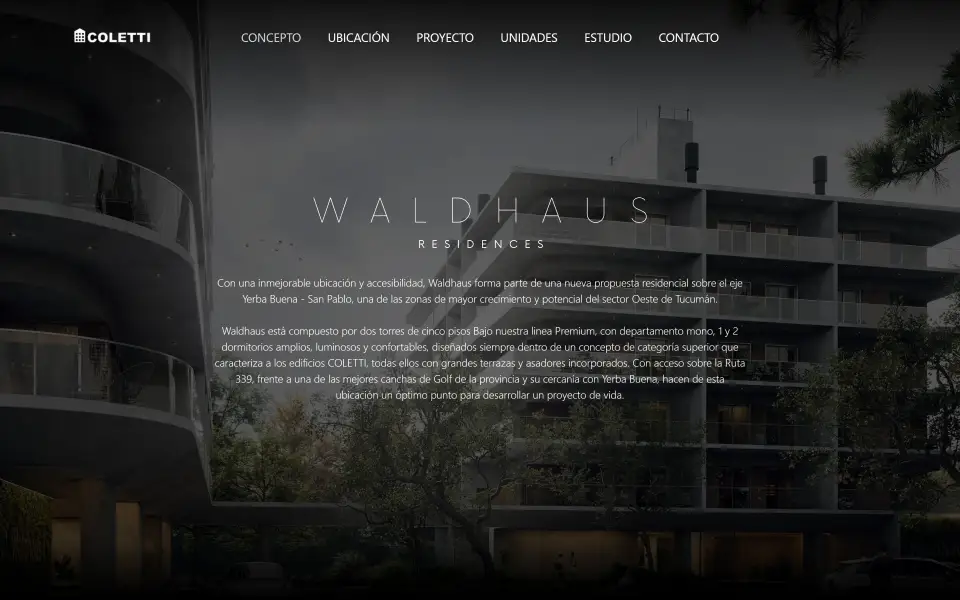
Website for a real estate development in San Pablo, Tucumán. A single page: the sales path is linear and navigation should not compete with it.
| Client | Coletti Construcciones · Tucumán |
|---|---|
| Type | freelance |
| Platform | Next.js |
| Year | 2025 |
| Role | Full-stack, end to end |
| Stack | Next.js · React · Headless UI · Framer Motion · react-scroll · react-countup · Vercel |
| Own commits | 42 of 42 · git log, sole author |
| Code | 1,682 lines · git ls-files tsx/ts |
| Components | 8 components |
Context
A real estate development sold before it is finished. The material is renders, location and unit types, and visitors arrive with a single question: whether this suits them or not.
Options
The usual approach is a site with sections: home, the project, units, location, contact. Five pages, five navigation decisions, and a visitor who can skip the order in which the information makes sense.
Decision
A single page. The sales pitch is linear —what it is, where it is, which unit types exist, how far construction has progressed, how to get in touch— so the page follows it and scroll is the navigation. Eight components in total.
The detail that justifies the dependencies: react-scroll so the menu takes you to each
section with controlled scrolling, and react-countup for the construction progress
figures. On a single-page site, those two are the entire navigation.
Verification
42 of 42 commits are mine. 1,682 lines, 8 components, one route. In production.
Consequences
A single page means all the weight is in the first load and there are no deep URLs: you cannot link to “the two-room unit type”. For a development with a dozen units it is the right trade-off; with a hundred, it would not be.